Your Health. Your choice.
Search and find a trustedFind your trusted Doctor
What are you searching for
Where
My current location
Popular specialties
Popular conditions and procedures
Specialists

Bobby Huda
Endocrinology & Diabetes

Yannis Alexandrides
Cosmetic (Aesthetic) Medicine

Kael Cockcroft
Psychology

Mike Comins
Cosmetic (Aesthetic) Medicine

Korosh Majidi
Dentistry

Monica Vithlani
Dental Care

Robert T Johnston
Cardiology

Michael Snell
Osteopathy

Anne M Gilvarry
Ophthalmology

Mark Norton
Orthopaedic Surgery
Popular specialties
Popular conditions and procedures
Specialists
Bobby Huda
Endocrinology & Diabetes
Yannis Alexandrides
Cosmetic (Aesthetic) Medicine
Kael Cockcroft
Psychology
Mike Comins
Cosmetic (Aesthetic) Medicine
Korosh Majidi
Dentistry
Monica Vithlani
Dental Care
Robert T Johnston
Cardiology
Michael Snell
Osteopathy
Anne M Gilvarry
Ophthalmology
Mark Norton
Orthopaedic Surgery
Start your search...
We’ve helped over 3 million patients like you find the right specialist
Choose from over 30,000 experts.
 Professor Matthew Winter
Oncologist
5
Verified
When i learned what my treatment plan would involve, Professor Winter came highly recommended. From the very first time we spoke, Matt went out of his way to ensure I understood every step of the treatment process, breaking it down into manageable and clear explanations, which was super helpful given how much I needed to take in. Throughout my treatment journey, Matt was exceptionally thorough in making sure all the necessary tests were done and he kept me updated on any developments. When I received my diagnosis it was extremely difficult for me to work through initially, however having Matt as my Oncologist and the support he gave really helped me navigate what I needed to do. I always feel comfortable asking questions, even if I was unsure about something, as Matt was very open and honest with me from the start. Matt's approach made such difficult time, more manageable and im extremely grateful for the care and empathy I received. Huge thank you to Professor Winter and his team of amazing nurses, who looked after me and laughed with me throughout the many months of treatment I received.
Seen for:
Breast Cancer Mayfair Health
Physiotherapy
5
Verified
I’ve been seeing James since summer last year for various lower body ailments, namely (i) left knee ACL revision surgery in Sept 2025 and (ii) right hip / labral tear issues. I was recommended Mayfair Health by Tim Spalding after seeing some not so great physios and struggling to progress with my knee - many thanks to whoever I spoke to from the front desk who organised my appointment James. James has been really fantastic with my prehab and post surgery rehab and without him I’d probably still be hobbling around. He is super supportive, encouraging, knowledgeable and patient, all things one looks for in a good physio (I’ve recommended him and the team to many of my friends!) I was very anxious about needing to re-do my ACL for the second time but with James’ support I have been able to change my mindset and see the positives in the situation - sessions are always a laugh (because you can only laugh or cry in such situations), even when I needed to learn how to walk again. Thanks James and team, looking forward to progressing with my rehab and one day doing a Hyrox!
Seen for:
Post-Operative Rehabilitation Dr Elliot Smith
Cardiologist
5
Verified
Elliot Smith inspires confidence and exudes competence from the instant one meets him. What makes him rather special though, is his warm, approachable manner and the fact that he takes the time to listen to his patients before providing a well- reasoned opinion on which he bases his recommended course of action in simple, straight-forward terms. His leadership skills did much to quell my anxiety on the day of my procedure, when he calmly took charge of the operating environment and made me feel that by choosing the team at Barts, I had the best hands caring for me. His interaction with his colleagues was also noteworthy, speaking not only of an excellent doctor, but of a truly decent human being. Debbie has to be one of the most efficient PAs I have ever encountered. She made the arrangements seem effortless and dealt with all my queries in double-time and is a real asset to this cardiology practice.
Seen for:
Angioplasty Miss Harleen Deol
General Surgeon
5
Verified
Miss Deol is an absolute standout — warm, friendly, and genuinely compassionate. She always looks happy to see me, listens carefully, and explains everything in a way that feels easy to understand. I’ve always felt completely comfortable asking questions, and she makes herself available to go over any concerns without ever making you feel rushed. She’s quick, too — she does exactly what she says she will, without leaving anything hanging or putting follow‑up stress back on the patient. I really appreciate that level of reliability and care. She tackles issues head‑on, follows through, and you always feel supported and safe throughout the process. I’m very happy with my recent bilateral mammoplasty. The results, the care, the whole experience — exceptional. I would very highly recommend Miss Deol. She’s a lovely, talented clinician you can trust completely. You’re in excellent hands with her.
Seen for:
Breast Cancer Beautiful Lifestyle Health Clinic
Holistic Therapy, Neurology
5
Verified
I found Dr Danciut to be a genuinely inspiring and caring person, as well as a skilled communicator. The approach is based in science and evidence and skillfully tailored to my own personality and lifestyle. I found the first session really challenged a lot ofnmy pre-conceived notions of things I felt I couldn’t change, and offered me the structure and confidence to start small and build. I have implemented the dietary and lifestyle changes she recommended and have stuck with them for more than 6 weeks without ever feeling I was ‘following a program’. The clinic letters are incredibly detailed are very helpful to anchor the recommendations from the session. Hands down this has been an inspiration to me to implement many positive changes straight away!
Seen for:
Lifestyle Change Nuffield Health Newcastle
Plastic Surgery, General Surgery, + 6 more
5
Verified
"My consultation with Mr Harkiran Seehra was incredibly reassuring. From the start, his compassion and warm manner made a difficult situation much easier to navigate. It is rare to find a consultant who balances world-class expertise with such genuine, patient-centred care. He took the time to listen to my concerns without rushing, explaining every detail of my treatment plan with absolute clarity. His decades of experience are evident, yet he remains incredibly approachable and kind. I felt completely safe in his hands and cannot recommend him highly enough for anyone seeking a truly dedicated specialist."
Seen for:
Rectal Bleeding Dr. Wisam Alwan
Dermatologist
5
Verified
Dr Alwan provided a very comprehensive assessment of my current condition based on specific appropriate questioning re my symptoms. He also undertook an examination of my skin in a variety of areas to assist his diagnosis. He listened to my concerns and was very supportive and understanding in his approach. A lovely Dr who understood my pain and for the first time I actually felt “heard”. I would highly recommend anyone with a severe skin problem to seek his advice.
Seen for:
Inflammatory Skin Conditions Mr Ben Eddy
Urologist
5
Verified
I was referred to Mr Eddy following a Prostate Cancer diagnosis. He was very thorough in explaining the surgical procedure to me along with the pros and cons. His calm factual manner, alongside his friendly demeanor, gave me confidence to proceed with the operation. He then performed the procedure and follow up appointment. In all dealings with Mr Eddy he was factual but compassionate and I always felt I was in good hands.
Seen for:
Prostatectomy (Robotic) Mr Kam Cheema
Orthopaedic Surgeon
5
Verified
I am so lucky that I was put under Mr.Cheemas care. The service I received was second to none. Mr.cheema is an amazing surgeon and person, he took the time to explain my procedure clearly and to reassure me. On the day of the surgery and after Mr.Cheema spoke with me putting me at ease.. He contacted me at home checking in on me throughout my six week period to date, his aftercare service could not be better.
Seen for:
Joint Replacement London Digestion
Gastroenterology, General Surgery
5
Verified
A totally brilliant experience. Problem has been no notion of what follow-up would be and then follow-up letter didn’t go to my address as they’ve got the number of the road wrong so that led to a worrying time but the experience itself and the lovely person who did the ultrasound was really terrific and the white seats facing the view well you might as well as been on holiday, so thank you
Seen for:
Colonoscopy Harley Street Hearing
Audiology, Ear Care
5
Verified
I'm happy with the service provided by Harley Street Hearing and their administrative staff.. I've never had to wait for my hearing appointment for more than 5 minutes, which makes a change, as I hate waiting , especially when I've made the effort to be on time. Making or cancelling an appointment is easy and there's a buzz about the place which I've never experienced in a practice.
Seen for:
Hearing Aids Mr Shamsi El Hasani
General Surgeon
5
Verified
Mr El Hasani performed surgery on me on 21 Feb 2026. The latest visit was the (hopefuuly) final one post op. I found Mr El Hasani very professional. He was clear in his explanations of what the issue was, the actions needed and how and what he would undertake. There were no suprises along the way and I am happy with the outcome.
Seen for:
Laparoscopic (Key-Hole) Surgery Mr Manzar Saeed
Ophthalmologist
5
Verified
Mr Saeed has been amazing! I have been treated so well by everyone during the treatment I have had. My vision now is as good as I could hope for at this stage of life. Though there were complications along the way mr Saeed was positive of a good outcome all the time and we are now there! The man is genius! Thank you. Glenda C.
Seen for:
Cataract Surgery Freedom Vision - Chelmsford
Ophthalmology
5
Verified
Wonderful, I cannot speak too highly of the staff, the practice and the swiftness and professionalism of the cataract surgery I received. From end to end - initial contact with Nicola Hendy through to the consultancy with Mr Hove, the surgery itself and the follow-up assessments everything was superb.
Seen for:
Cataract Surgery Nuffield Health Warwickshire Hospital
Cardiology, Chemical Pathology, + 9 more
5
Verified
Great experience at Nuffield Health Hospital Warwick, it the first time I've been in, and It left a positive feeling. Arrived on time for my appointment and only wait a couple of minutes to get seen by a doctor, pleasant reception area with amenities.
Seen for:
Haemorrhoids New Forest Psychiatry
Psychiatry
5
Verified
I saw doctor Gordon he is a very clear and easy person to talk to with great understanding and knowledge and treats you with respect and calmness which is important .i feel very safe in his Company and is helping me on my way to wellness.
Seen for:
Attention Deficit Hyperactivity Disorder (ADHD)
Discover doctors admired by their peers through skill endorsements.
Most popular specialties
See all specialties


Service areas we work with
Proudly trusted by
Promoting trust and transparency in healthcare
The Doctify pledge
We work with healthcare providers so they can truly understand their patients and provide the very best experience and care.Created by doctors
Doctify was founded by two surgeons. They are passionate about helping patients find the right specialist or clinic by providing them with the right guidance and information.Meaningful insights
We want to make sure that patients have access to the very best services in healthcare in a trusted, transparent manner.Secured & trusted
We ensure patients have access to the very best quality information in a way they understand.Hear from our clinicians


Dr. Fas Arshad
Cosmetic Doctor

Mr Ahmed Khalil
Obstetrician & Gynaecologist

Mr Christopher Macdonald
Plastic Surgeon

Ms Meranda Gomez-Adams
Dental Care Professional

Dr. Sameh Abdulsamea
Paediatrician

Ms Neena Garg
Obstetrician & Gynaecologist

Dr Amal Muthumala
Cardiologist

Dr Emma Noble
General Practitioner
Doctify for providers
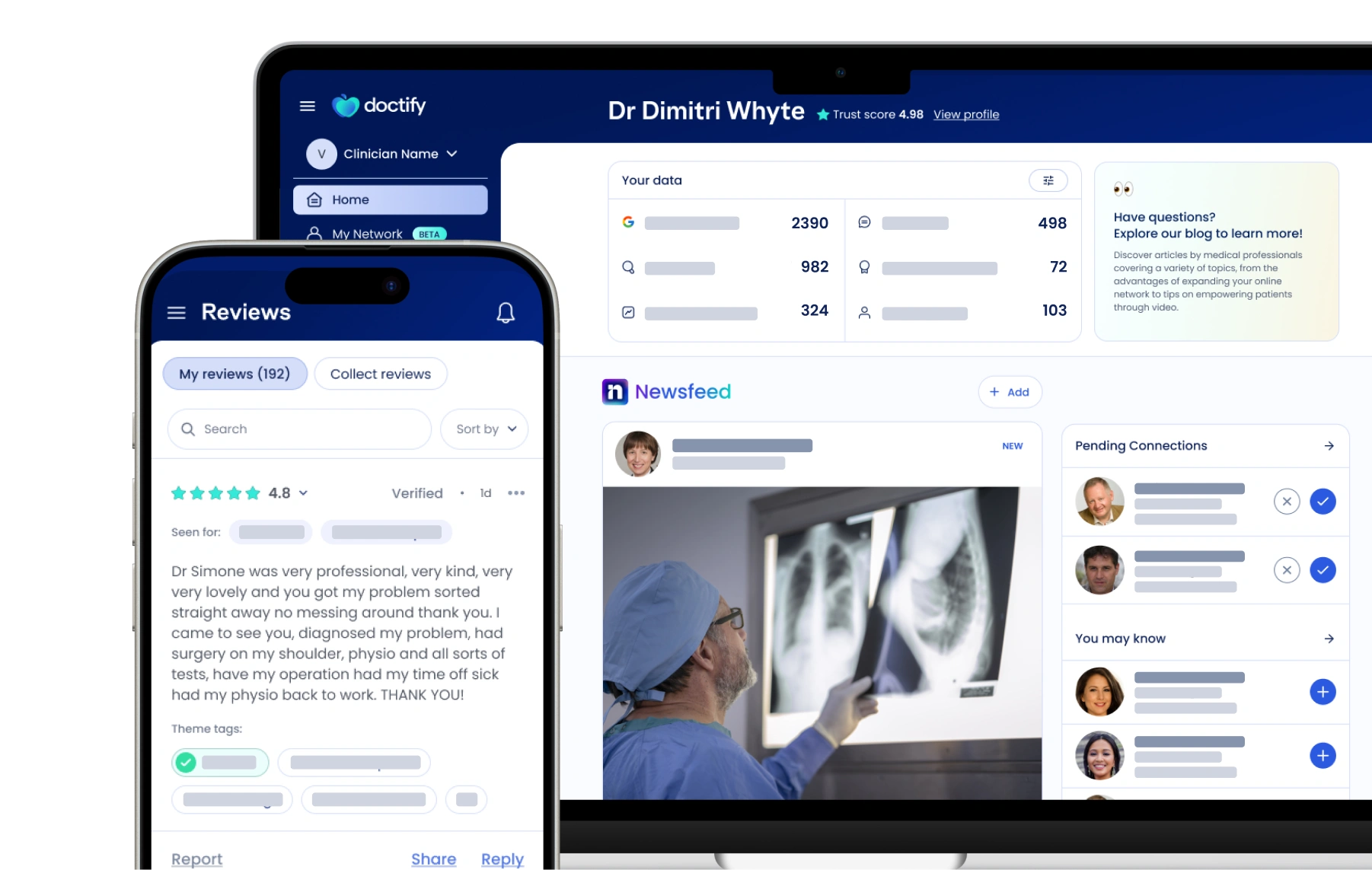
Join thousands of other providers who have signed up to our trust & transparency pledge and give your patients a voice.
Collect verified reviews using our digital tool
Validate your key expertise
Connect, engage and understand your patients
Real-time insights into your care
Connect with other healthcare professionals