
The shift: AI is becoming the new front door to healthcare
For decades, the way patients found healthcare barely changed. They relied on GP recommendations, hospital networks, and the occasional paper directory. If you weren’t in the booklet or on the noticeboard, you simply weren’t found.
Then came the first big shift: Google.
Suddenly, patients could:
- search for specialists,
- compare clinics,
- read reviews,
- and browse websites, all within seconds.
For nearly 20 years, Google was the centre of digital healthcare discovery. Entire industries grew around helping practices “rank on page one”.
But we’re now entering the third major transformation in search, one that is unfolding much faster than the last two.
Today, patients aren’t just typing symptoms into a search bar.
They’re talking to AI tools such as ChatGPT, Gemini, Perplexity, Microsoft Copilot and Google’s AI Overviews to help them understand symptoms, compare specialists or find a trusted clinician nearby. Half of consumers now intentionally seek out AI-powered search engines, with these tools quickly becoming the preferred way to research and make decisions across categories, including healthcare (McKinsey, 2025).
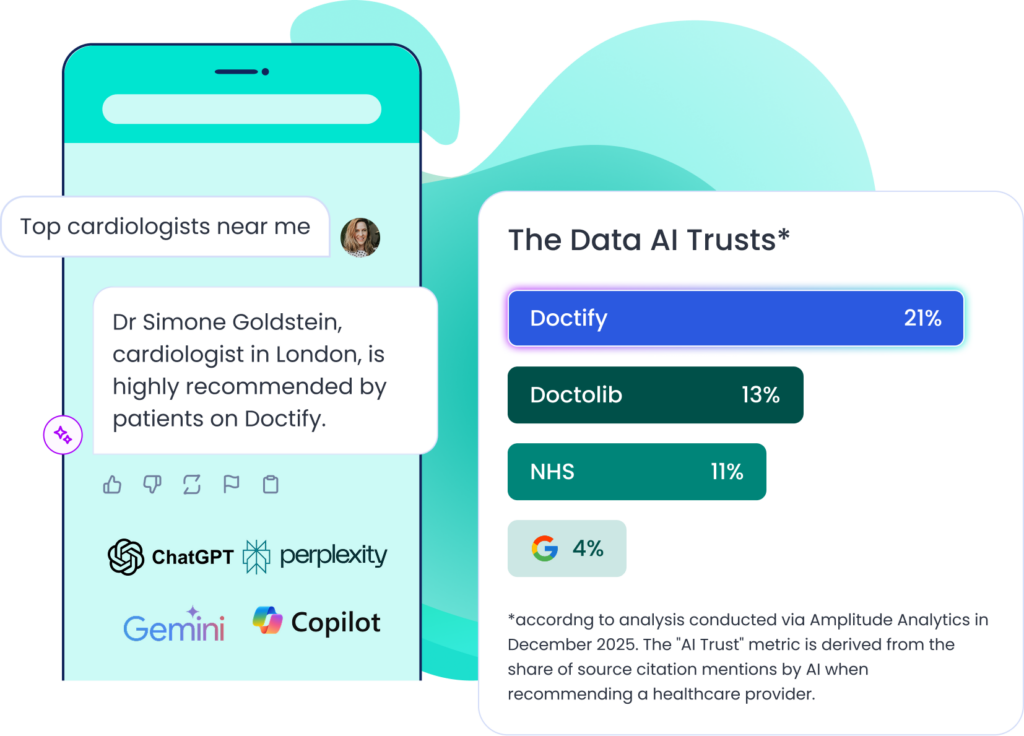
That shift gives AI enormous influence over which clinicians get discovered. But AI can’t judge expertise on its own – it looks for external validation. Verified reviews, consistent professional profiles and authoritative third-party platforms become the signals AI depends on when deciding which clinicians to mention.
Why AI chooses some healthcare providers, and ignores others
Because of this, AI assistants don’t rely on your practice website the way Google once did. Instead, they pull information from sources they consider trustworthy, verifiable and independent.
Recent research shows:
1. AI relies heavily on third-party sources
A study analysing over 40,000 AI responses found that AI tools cite third-party content significantly more often than brand-owned websites. Independent platforms, review sites, medical directories and user-generated content form the largest share of sources in generative AI outputs (Search Engine Journal, 2025).
2. Consistent presence across trusted platforms makes you more likely to be surfaced
AI models cross-check multiple databases. When your name, reviews and profile appear consistently across independent, authoritative platforms, your likelihood of being mentioned increases (Jarts.io, 2024).
3. AI looks for strong trust signals – especially verified reviews!
Generative search systems prioritise credibility and authority signals such as:
- verified feedback
- accurate, consistent profile information
- structured, easy-to-parse data
- reviews containing clear sentiment and contextual detail
- expert-authored, factual content
Verified reviews show that you’re an active, real practitioner, that patients interact with you regularly, and that your reputation is validated by a third-party platform. These elements help AI models recognise a clinician as a trustworthy source and increase the likelihood of being referenced in AI-generated answers (Exposure Ninja, 2024).
These credibility signals align closely with Google’s E-E-A-T framework: Experience, Expertise, Authoritativeness, and Trustworthiness (core factors that Google’s algorithm uses to evaluate and rank content in the search results), which AI systems also use to evaluate the reliability of medical content.
What this means for healthcare providers
AI systems are cautious about recommending clinicians. To protect users, they prefer sources that:
- verify identities
- vet reviews
- maintain structured medical data
- minimise misinformation risk
This is exactly why third-party healthcare platforms like Doctify matter more than ever.
Doctify provides:
- verified patient reviews
- clinician identity checks
- structured profiles with conditions, treatments and locations
- consistent, medically grounded information
- expert-driven content (Q&As, articles, videos)
These are precisely the signals AI models prioritise when deciding which clinicians to surface.
Entity consistency across the web, where a clinician’s name, specialty, reviews and locations match across sources, becomes a powerful trust indicator for AI.
If AI cannot find strong, external proof of your reputation, it is less likely to mention you at all.
In the age of AI search, visibility increasingly depends on your presence across trusted third-party platforms, not just your website.
Why verified patient reviews matter in AI search
Across multiple analyses, a clear trend emerges: AI depends on reviews to understand reputation.
Verified reviews provide what AI needs most:
- real patient experiences
- sentiment
- context
- outcomes
- bedside manner feedback
- volume and consistency signals
AI models are trained on this type of content and use it to build safe, reliable recommendations (Exposure Ninja, 2024; SEJ, 2025).
Verified reviews outweigh unverified feedback
Because healthcare is a high-stakes category, AI systems rely on sources they consider authoritative and trustworthy. Analyses show that generative search models often cite third-party platforms more than brand-owned content, especially when those sources offer structured, independently verified information
But reviews alone won’t guarantee visibility. A clinician with only reviews but non-verified reviews and/or an incomplete or sparse profile may still be skipped by AI. This is why having verified reviews, complete profiles and consistent information on reputable healthcare platforms strengthens a clinician’s visibility in AI-driven search.
Putting it all together: why Doctify matters
When a patient asks an AI tool:
- “Who is the best ENT surgeon for chronic sinus issues?”
- “Which paediatricians are good with nervous or autistic children?”
- “Who are the top cardiologists near me with good reviews?”
the AI checks:
- Is this clinician verified?
- Do they have consistent, structured information across trusted sources?
- Do they have a strong record of independent patient reviews?
- Does a reputable platform validate their identity and practice?
Doctify provides exactly those signals.
How to make your Doctify profile AI-ready
Here are three practical steps to help ensure AI systems can find and confidently recommend you:
1. Keep your profile complete
AI deprioritises incomplete information. Ensure your:
- bio uses clear, patient-friendly language
- conditions and treatments are fully listed
- clinic locations, languages and subspecialties are accurate
- profile remains consistent with hospital and practice websites
2. Collect verified patient reviews consistently
AI prefers:
- recency
- volume
- authenticity
- descriptive, experience-rich reviews
3. Maintain consistency across the web
Your Doctify profile, Google Business profile, hospital pages and personal website should all reflect the same details.
Entity consistency = credibility.
The bottom line
AI search is transforming how patients discover healthcare professionals. It relies heavily on independent third-party platforms, verified reviews, and structured, trustworthy data, such as clearly listed specialties, conditions treated, procedures offered, and clinic information that AI can parse and validate.
Healthcare providers who maintain a strong presence on trusted platforms like Doctify are more likely to be:
- recognised reliably as an entity
- validated as credible
- surfaced in AI-driven patient recommendations
When patients ask AI, make sure it knows who you are.
Ready to boost your visibility in AI search? Start with Doctify today.